

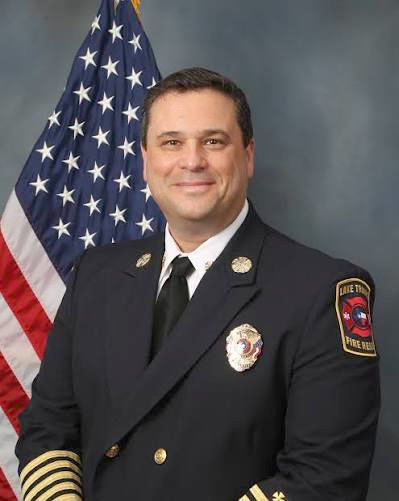

By LYNETTE HAALAND, Four Points News
Lake Travis Fire Rescue Chief Robert Abbott can still take himself back to Labor Day weekend 2011 — that Sunday began like a holiday but quickly became one of the most challenging days the department had ever faced.
The region was in a severe drought, with nearly 100 days of triple-digit temperatures, low humidity and high wind, Abbott recalled.
On September 4, 2011, wildfire was reported moving toward Steiner Ranch at 3:58 p.m. A few minutes earlier on that Sunday afternoon, electrical lines along RM 620 near Mansfield Drive “had enough slack to slap and arc, causing molten metal to fall onto combustible grass,” Travis County Fire Marshal Hershel Lee would later say.
The fire, which started on an undeveloped residential lot, was carried by embers across 620, igniting dry vegetation and moving into Steiner Ranch.
Abbott got the call minutes later. He was off duty. His title then was assistant fire chief of Lake Travis Fire Rescue Travis County Emergency Services District No. 6.
“Once it crossed 620, the conditions were such, and along with the direction of the wind, that it just took off,” Abbott recalled.
The fire moved quickly into Steiner Ranch, where residents were spending the holiday weekend at home, preparing to barbecue, running errands or returning from activities outside of the community.
An evacuation was ordered and suddenly, a community of some 10,000 residents was trying to leave while firefighters and emergency personnel were trying to get in.
“It was definitely not something we’d experienced before,” Abbott said.
The Travis County Sheriff’s Office took responsibility for traffic, and Abbott said the experience exposed challenges that the local public safety agencies had not previously encountered to that scale.
The fire itself presented an immediate and daunting challenge.
Abbott said LTFR had enough firefighters and trucks when the fire jumped 620 but the speed at which the fire grew made it extremely difficult to contain.
“It wasn’t a staffing issue,” Abbott said. “It was just a matter of how fast it jumped. And once it got picked up by the wind, it was gone.”
Aerial firefighting resources were limited. Central Texas did not have the kind of immediately assigned air resources that are used in some areas of California when wildfire conditions become critical, he said. Some state resources were available, but they were positioned elsewhere.
That day major fires were also burning in Bastrop, Pflugerville, and Spicewood.
Ultimately the fire destroyed 23 homes in Steiner. Residents were allowed back in two days later.
Soon after the event, the fire department began examining what had gone well, what had not, and what it had not even realized needed to be addressed.
Training became a major focus. The department began working more closely with other agencies, examining communication problems identified in after-action reports, and looking at how to make a large-scale response more seamless.
Wildfire response itself had to be reconsidered.
Abbott said many agencies had been approaching wildfires much like structure fires. But while structures may be threatened by a wildfire, the wildfire itself is the larger problem.
“We had to adapt a lot of our processes to how we responded to them,” he said.
That meant becoming more comfortable requesting outside resources earlier, adjusting staffing and cross-staffing and significantly increasing training.
Fifteen years later, Abbott and public safety officials still study what happened.
A staff ride planned in September will bring public safety professionals together to revisit the fire, examine decisions and share lessons with other departments.
It is about understanding what happened — and making sure the community and the firefighters who protect it are better prepared the next time wildfire threatens.