


- By PIPER GUINN, Austin Free Press
The former 3M facility in Northwest Austin is getting a potential data center makeover that appears to bypass efforts by Gov. Greg Abbott and the Austin City Council to pump the brakes on these resource-intensive facilities.
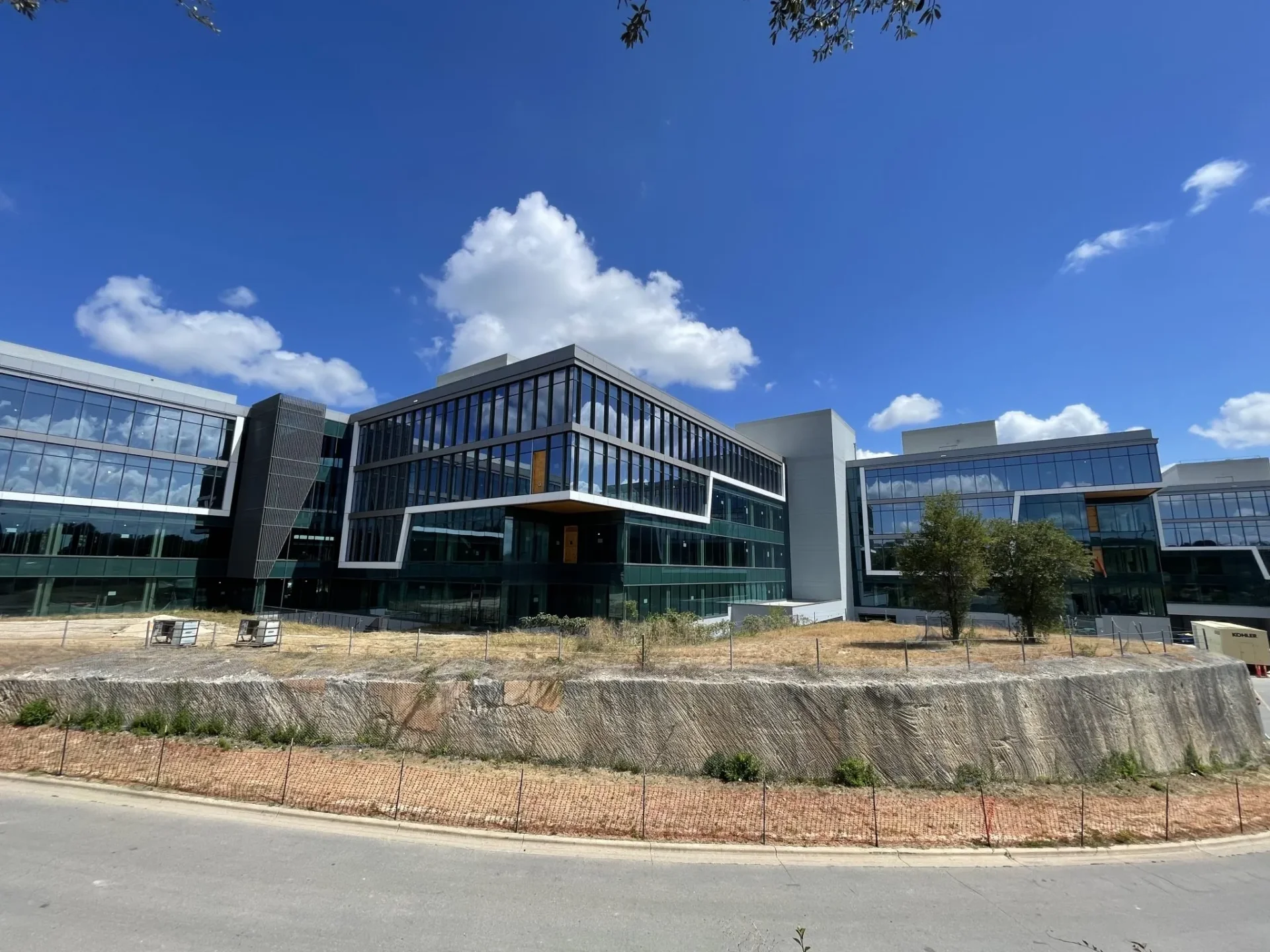
Located at 6801 River Place Blvd. near the River Place and Four Points neighborhoods, the new Cosmos Technology Campus spans 1 million square feet. It will host up to 50 megawatts of critical IT capacity at peak use, including “data centers,” according to a securities filing by parent company SB Energy.

Credit: Piper Guinn of Austin Free Press
The International Code Council defines data centers as buildings “used primarily to house information technology equipment” with a density greater than 20 watts per square foot at peak use. The city has just begun exploring potential data center rules, leaving a regulatory vacuum for now. With seemingly nothing in its way, construction has begun at the Cosmos campus, as first reported by the Austin Business Journal.

“The city could not pass retroactive zoning that requires (SB Energy) to dismantle the data center,” District 7 Council Member Mike Siegel told the Austin Free Press, explaining why the city has limited authority to regulate a project that is already permitted.
Local leaders will join residents at a town hall about the Cosmos development on Thursday, Sept. 17, from 6:30-8 p.m. at Four Points Middle School, 9700 McNeil Drive.
Don’t say ‘data center’
Although the site was zoned and approved for research and development, SB Energy’s Aug. 31 filing with the U.S. Securities and Exchange Commission says that the campus has leased space to SB Energy’s indirect subsidiary SE Cosmos “primarily for data centers and office buildings.”
Linda Bailey has lived a mile from the Cosmos campus for 26 years. She said that SB Energy previously told her and her neighbors that the site would not become a data center. Now, she’s concerned how noise, light and air pollution will impact nearby neighborhoods and schools.

“The SEC filing said (Cosmos) was a data center — no mention of research and development … what the heck?” Bailey said.
Community members spoke with SB Energy representatives on Sept. 8, Bailey said. “They understand there’s been a gap in communication, but they would not say the word ‘data center,’” she added. SB Energy did not respond to a request for comment from the Austin Free Press for this story.
Such transparency issues have been a recurring data center issue. With 258 data center proposals pending statewide, the Texas Public Utility Commission surveyed them in 2025 to gauge their power and water needs. Just 17% of them responded, the Texas Tribune reported.
Mixed messages
Current Cosmos renovations will support its first tenant, Graphcore, which shares the same parent company and is known for semiconductors and rack-scale computer systems. Graphcore will use the site for “research, development, and engineering related to advanced AI compute technologies,” according to a project fact sheet.
“The best information the city has about this site is that it is intended for use as a technology research and development center, not a large-scale data center,” a city representative told the Austin Free Press.
This conflicting information leaves even council members scratching their heads.

“The ambiguity surrounding the ultimate scope of the plan is disturbing,” District 10 Council Member Marc Duchen said.
SB Energy, which develops and owns data center infrastructure around the country, closed on the property in March 2026, per the security filing. By then, Cosmos already had obtained all the necessary building permits, with the first phase of construction expected to conclude by spring 2027. As of June 30, the data center construction phase had not commenced.
Powering the Cosmos
Extending service to a potential data center has drawn scrutiny from Austin Energy ratepayers concerned about impacts on electricity demands and costs. Austin Energy is completing substation and transmission upgrades that Cosmos requested, as the facility will have “significantly higher power density than traditional office or laboratory equipment,” according to SB Energy’s fact sheet.
Once connected, Cosmos will have access to 50 MW of IT power, enough to run roughly 40,000 households. An additional 25MW will be available for office uses, SB Energy told neighboring residents on Sept 8.
Austin Energy must approve all interconnection requests within its service territory regardless of their demand needs, and customers need not disclose how they will use the power, according to Austin Energy General Manager Stuart Reilly.
Austin Energy receives power from the state grid regulated by the Electric Reliability Council of Texas. ERCOT sets local energy rates and available power supplies based on total consumption within a service area. Demand increases within a service area can impact energy reliability and costs.
“Austin Energy studies reliability impacts before new customers can be interconnected to ensure there are no impacts to the system,” the utility wrote in a statement to the Austin Free Press. Austin Energy requires “new customers to pay 100% of the costs necessary to serve them.”
Cooling the Cosmos
A facility equipped with rack-scale computer systems also requires significant water for power generation and cooling. Based on International Atomic Energy Agency estimates, a typical 50 MW data center would use around 265,000 gallons of water a day, equivalent to the daily water use of almost 900 U.S. households.
Austin Water also is obligated to serve any service request within its area. Even as Austin Water faces a potential supply shortage, the city cannot categorically deny a large volume user. The utility is reviewing SB Energy’s request, according to the city’s planning dashboard.
“If the city council were to decide not to serve a property, we would have to seek to release that property from our (service area) with the Public Utility Commission of Texas,” Austin Water Director Shay Roalson said at an Aug. 25 city council work session.
The city’s land use code requires Cosmos to connect to reclaimed water lines and develop an onsite water reuse system. SB Energy’s fact sheet states that it will use closed-loop cooling systems that conserve water, and that Cosmos “will not consume more water than the previous tenant.”
“Wild West”
Data centers can consume a lot of power and water, which can strain available supplies of those resources and drive up utility bills. Facilities with their own fossil-fuel generators also can pollute their neighborhoods. These challenges have prompted state and local governments to rush to exert some controls on these facilities.
“Nothing in city code or regulations right now requires the Development Services Department, Austin Energy, or Austin Water to verify whether or not a data center is being built,” Siegel said. The council adopted an Aug, 27 resolution that directs city staff to create a data center zoning category and new regulations to mitigate data center impacts on local power and water resources, as well as surrounding neighborhoods. The first staff update on those plans is expected in December.
Aside from Cosmos, Siegel said few large-load customers are awaiting Austin Energy hook ups. But he said there’s an urgent need to prevent large data centers from coming here.
“It has been a Wild West of sorts, and that’s why emergency action is needed,” Siegel said.
Meanwhile, Gov. Greg Abbott has directed ERCOT to postpone any proposed data centers that would consume more than 25 MW of power while the state audits their total power and water needs. State officials have not been clear about if this mandate applies to facilities already under construction, such as Cosmos.
River Place and Four Points residents are calling for transparency from SB Energy. Bailey said that she and her neighbors are not opposed to a data center; they just want the truth.
“We want to know what’s going to be built there,” she said. “We deserve to know.”
Piper Guinn is the health equity reporter for the Austin Free Press, covering the disproportionate health burden carried by the city’s most vulnerable. Piper is a native Texan and recent graduate of Whittier College, where she received a B.A. in political science.