

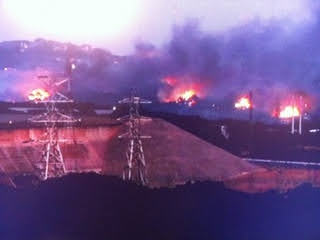
The 2011 Labor Day weekend fires destroyed 23 homes in Steiner Ranch and
caused a two-day evacuation of some 10,000 residents. Fifteen years after the Steiner Ranch fires, Lake Travis Fire Rescue has changed how it prepares for wildfire —and the community has changed with it.
By LYNETTE HAALAND, Four Points News
The Steiner Ranch fires of 2011 did more than test Lake Travis Fire Rescue’s ability to fight a fast-moving wildfire. They changed the way the department thinks about wildfire.
Fifteen years later, that change can be seen in fuel mitigation, firefighter training, emergency communications, technology, evacuation planning and a growing expectation that residents themselves have a role in reducing wildfire risk.
Chief Robert Abbott describes the biggest shift simply: “We don’t want to be reactive anymore,” he said. “We want to be well-planned.”
Starting with the fuel
In the years following the fires, Lake Travis Fire Rescue/Travis County Emergency Services District No. 6 began developing a fuel-mitigation program based on lessons from communities that had experienced repeated wildfires.
The program began as a small pilot project and has since grown into a full-time operation included in the department’s $35.8M budget. LTFR says the program was launched in early 2012 as a direct response to the 2011 fires.
The work includes prescribed burns and other treatments designed to reduce wildfire fuels, including shaded fuel breaks.
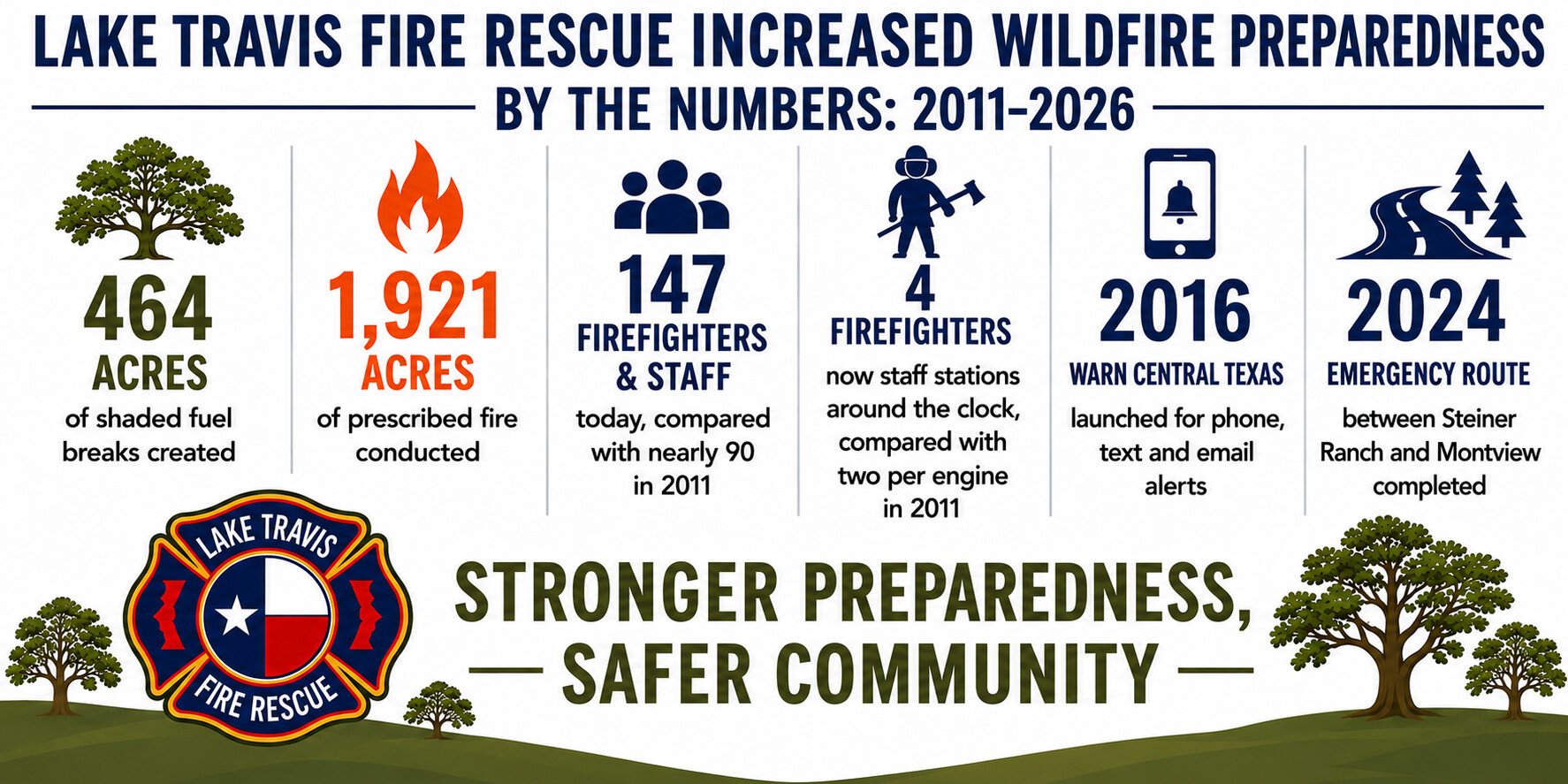
The LTFR fuels mitigation team has averaged 33 acres of shaded fuel break per year since 2012, and has been responsible for roughly 464 acres of shaded fuel break and 1,921 acres of prescribed fire since 2012. As for prescribed burns, LTFR has a five-year average of 380 acres treated per year.
Abbott said areas where treatments have been completed have not experienced large fires. Smaller fires have occurred, he said, but were contained without growing significantly.
The work, however, is never finished.
Vegetation grows back. Wet seasons can increase the amount of available fuel, while ice storms can leave dead trees and limbs on the ground.
“The mitigation efforts really go a long way,” Abbott said. “But they’ve got to be sustained.”
LTFR currently has eight personnel dedicated to wildfire mitigation and fuels reduction efforts. Through a combination of reimbursements and cost-share programs, the department can sustain these initiatives while using only 1% of LTFR’s overall operating budget. LTFR says its program has now treated more than 180 acres, generated thousands of cubic yards of chipped material and directly impacted thousands of homes.
Funding followed the lessons
LTFR’s budget increased by $25.4 million over 15 years from just over $9 million in fiscal year 2011 to $35.8 million in FY 2026.
The department’s mitigation work also began attracting outside funding. Abbott said grants started becoming available around 2015 or 2016, with early awards generally ranging from $50,000 to $100,000.
The department has also worked with homeowners associations and communities on grant applications and mitigation projects.
Abbott said dozens of projects have been completed over the years.
The department initially used its own funding to establish the mitigation program, despite concerns about whether public safety dollars should be spent on prevention.
But Abbott said prevention is public safety.
“If we’re always in a reactive mode, which we are when we respond from a fire station, we want to make sure that we’re providing the community with something that beats to the punch before it gets big,” he said.
Station and staff growth
LTFR services 104 square miles.
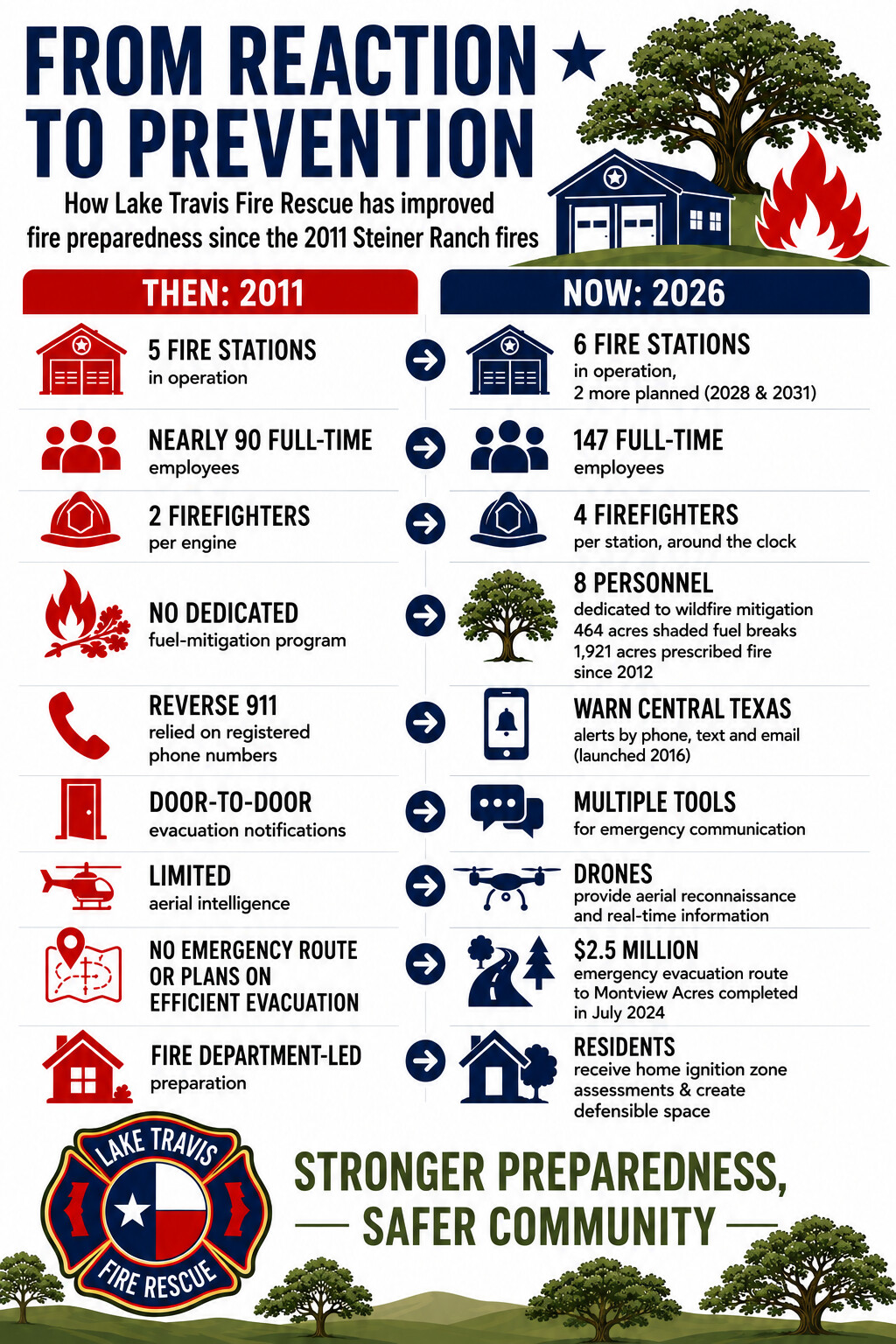
In 2011, LTFR was operating five fire stations including one in Steiner. It had two firefighters per engine
and nearly 90 full-time employees. By 2015, all of its stations were staffed with four firefighters around the clock.
“LTFR has maintained the highest level of emergency staffing assigned to fire engines, ladder trucks,
and emergency squad units,” according to LTFR. “These levels have been maintained since.”
Today, it serves roughly 77,000 people with six stations and 147 full-time employees. Today LTFR operates six fire stations and plans to build two new stations – one in 2028 and one in 2031.
A different way to fight fire
The department also changed how it responds. Training expanded. LTFR worked with other agencies to develop a more coordinated response, and firefighters became more comfortable requesting additional resources earlier when conditions warrant them.
Abbott said the department also learned that wildfire cannot simply be treated as a structure-fire response. “We had to adapt a lot of our processes to how we responded to them,” he said.
That included changes in staffing and cross-staffing as well as expanded education about environmental
conditions, topography and fire behavior.
Communications with residents
When the Steiner Ranch fires struck in 2011, Warn Central Texas did not yet exist.
Travis County had a regional emergency notification system called Reverse 911 that could call phone
numbers. But many Steiner Ranch residents had not registered their cell numbers, which meant some received calls and others did not.
Law enforcement went door-to-door to share about the fires and evacuation. Word got out through social media and neighbors telling neighbors as well. Travis County created a public information phone number
where evacuees could get information.
The regional emergency notification system Warn Central Texas was launched in 2016, giving local
officials another way to send emergency instructions directly to residents by phone, text and email. Residents can sign up at WarnCentralTexas.org. Technology changed, too
The tools available to firefighters have changed dramatically since 2011.
LTFR now uses AI for fire plume modeling and evacuation planning, while drones increasingly provide
aerial reconnaissance and information that can help incident commanders determine where units should be positioned and track fire activity.
Abbott said the department is also watching emerging technology that could eventually allow large
drones to carry water for fire suppression. The technology is still developing, but Abbott sees it as another example of how quickly wildfire response is changing.
Evacuation and emergency route built
The fire also reinforced the need for additional emergency access into and out of Steiner. After much debate on where it would go, Travis County built a $2.5 million evacuation route between
Steiner and the Montview Acres neighborhood.
The emergency-only route was completed in July 2024 and has been opened once so far during flooding on the July 4 weekend in 2025.
“Getting out of your area is getting out of your area,” Abbott said.
Although evacuation planning is important, Abbott said, so is understanding when residents should
shelter in place. If everyone leaves immediately every time a fire starts, he said, the resulting traffic can make it harder for firefighters to get into the area and begin fighting the fire.
His advice is to remain calm, and “listen to first responders and whatever their directions are,” Abbott
said.
Community became part of the solution
One of the most important changes, Abbott said, is that residents increasingly understand wildfire preparation is not solely the fire department’s job.
LTFR offers home ignition zone assessments to help residents identify risks around their homes and
prioritize improvements.
Defensible space does not mean clear-cutting a property, Abbott emphasized. It means creating conditions that can give residents more protection and firefighters more opportunity to defend a home.
“We need community members to take it upon themselves to at least handle their own house, handle their
own yard,” he said.
That philosophy has become a central part of wildfire preparedness in the area.
The lesson continues
Fifteen years after the fire, Abbott does not consider wildfire preparedness a finished project.
The landscape changes. Weather changes. Technology changes. And the community continues to grow.
For a community that experienced the chaos of a largescale evacuation 15 years ago, that may be one of the clearest signs of how far it has come.
The fire department is better prepared. The community is more aware. And the goal has shifted from simply responding to wildfire to doing everything possible to reduce the risk before the flames ever arrive.
That may be the most important legacy of the Steiner Ranch fires: the lessons of 2011 are still at work
15 years later.